UPSC GNCTD Principal & Vice-Principal Exam (2026)
Complete Selection Blueprint, Portal Interactive Test Schedule & Preparation Package
The Transition from an Educator to an Educational Administrator
As an experienced educator, your day-to-day work involves shaping minds, managing classrooms, and nurturing the future generation. However, stepping into the role of a Principal or Vice-Principal in the Directorate of Education (GNCTD) requires a fundamental shift in perspective. You are not just upgrading your designation; you are stepping into the boots of an administrator, a legal authority, and a financial custodian of a modern educational institution.
The Union Public Service Commission (UPSC) Special Advertisement No. 51/2026 formally invites applications for 124 posts of Principal (Vacancy No. 26075101725) and 704 posts of Vice-Principal (Vacancy No. 26075102725). UPSC has officially announced that the Pen & Paper Combined Recruitment Test (CRT) for both positions will be conducted on 1st November 2026.
1. Comprehensive Competition & Statistical Analysis
Understanding the statistical reality of the candidate pool is essential for setting realistic performance targets. Official RTI applicant disclosures juxtaposed against vacancy notifications and historical recruitment data (Advt. No. 10/2022) reveal important trends across both posts.
A. The Principal Cadre Analysis (124 Vacancies | 16,556 Candidates)
With only 124 total posts advertised, the Principal cadre presents a dense, highly competitive environment across all social and gender divisions:
- Overall Competition: 16,556 total applicants competing for 124 vacancies yields an overall average of 133.5 candidates per seat.
- General / Unreserved (UR): 37 male posts (5,774 applicants) result in 156.1 candidates/seat; 32 female posts (4,802 applicants) result in 150.1 candidates/seat.
- Scheduled Caste (SC): 13 male posts (1,875 applicants) result in 144.2 candidates/seat. Notably, 3 female posts against 930 applicants represent the single highest competitive concentration at 310.0 candidates/seat.
- Other Backward Classes (OBC): 7 male posts (1,188 applicants) yield 169.7 candidates/seat; 11 female posts (939 applicants) yield 85.4 candidates/seat.
- Scheduled Tribe (ST): 8 male posts (670 applicants) yield 83.8 candidates/seat; 2 female posts (205 applicants) yield 102.5 candidates/seat.
- Economically Weaker Section (EWS): 7 male posts (133 applicants) yield 19.0 candidates/seat; 4 female posts (40 applicants) yield 10.0 candidates/seat.
B. The Vice-Principal Cadre Analysis (704 Vacancies | 22,413 Candidates)
The Vice-Principal position exhibits a significantly higher statistical probability of selection due to a 5.38-fold expansion in total seats compared to the 2022 cycle (704 posts vs. 131 posts):
- Overall Competition: 22,413 total applicants competing for 704 vacancies yields an average of 31.8 candidates per seat. In 2022, 5,076 candidates competed for 131 posts (~38.7 candidates/seat).
- General / Unreserved (UR): 150 male posts (5,542 applicants) result in 37.0 candidates/seat; 137 female posts (5,501 applicants) result in 40.2 candidates/seat.
- Scheduled Caste (SC): 52 male posts (2,679 applicants) yield 51.5 candidates/seat; 51 female posts (2,123 applicants) yield 41.6 candidates/seat.
- Other Backward Classes (OBC): 96 male posts (2,106 applicants) yield 21.9 candidates/seat; 93 female posts (2,183 applicants) yield 23.5 candidates/seat.
- Scheduled Tribe (ST): 29 male posts (1,014 applicants) yield 35.0 candidates/seat; 25 female posts (739 applicants) yield 29.6 candidates/seat.
- Economically Weaker Section (EWS): 37 male posts (347 applicants) yield 9.4 candidates/seat; 34 female posts (179 applicants) yield 5.3 candidates/seat.
👉 CLICK HERE TO ENROLL NOW / GET INSTANT ACCESS
2. Examination Weightage, Qualifying Criteria & Historical Benchmarks
UPSC evaluates candidates through a two-stage process governed by strict mathematical parameters:
A. Evaluation Mechanism & Mandatory Rules
1. Recruitment Test (RT): Objective paper worth 300 marks consisting of 120 multiple-choice questions (2.5 marks per question). The exam duration is 2 hours, with a mandatory deduction of 1/3rd mark penalty for each incorrect response.
2. Interview Stage: Evaluated out of 100 marks.
3. Final Merit Weightage: Computed using a strict 75:25 ratio (75% weightage to RT marks and 25% weightage to Interview marks).
4. Mandatory Interview Thresholds: Candidates must satisfy category-specific minimum suitability benchmarks in the interview:
o UR/EWS = 50% (50 marks)
o OBC = 45% (45 marks)
o SC/ST/PH = 40% (40 marks)
o Failure to hit these interview thresholds results in immediate disqualification, irrespective of written test performance.
B. Historical Benchmarks (Vice-Principal 2022 Official Cut-Offs)
Understanding past cut-offs helps in establishing precise score targets:
- UR Category: Male RT Cut-Off = 111.68 / 300 | Final Cut-Off = 196.18 / 400. Female RT Cut-Off = 92.50 / 300 | Final Cut-Off = 177.00 / 400.
- OBC Category: Male RT Cut-Off = 98.33 / 300 | Final Cut-Off = 167.83 / 400. Female RT Cut-Off = 91.68 / 300 | Final Cut-Off = 163.00 / 400.
- SC Category: Male RT Cut-Off = 91.68 / 300 | Final Cut-Off = 150.83 / 400. Female RT Cut-Off = 80.83 / 300 | Final Cut-Off = 152.68 / 400.
- ST Category: Male RT Cut-Off = 95.00 / 300 | Final Cut-Off = 174.18 / 400. Female RT Cut-Off = 68.33 / 300 | Final Cut-Off = 140.83 / 400.
- EWS Category: Male RT Cut-Off = 55.83 / 300 | Final Cut-Off = 115.18 / 400. Female RT Cut-Off = 20.00 / 300 | Final Cut-Off = 79.18 / 400.
3. Syllabus (8 Domains)
i. General Knowledge including Contemporary Social, Economic and Cultural Issues
- · Indian Polity & Governance:
- o Constitutional Framework: Historical Background (1773–1935, 1947 Act); Constituent Assembly & Drafting Committee; Preamble & Features; Articles 1–11 (Union, Territory, Citizenship); Fundamental Rights (Articles 12–35, Writs); DPSPs & Fundamental Duties (Articles 36–51A); Article 368 Amendments & Basic Structure.
- o System of Government: Parliamentary vs. Presidential; Centre-State & Inter-State Relations; Emergency Provisions (Articles 352, 356, 360).
- o Central & State Executive: Union Executive (President, VP, PM, Council of Ministers, Cabinet Committees); Parliament (Lok Sabha, Rajya Sabha, Speaker/Chairman, Procedures, Budget, Committees); State Executive (Governor, CM, Council of Ministers); State Legislature.
- o Judiciary & Local Governance: Supreme Court, High Courts, Subordinate Courts; Administrative Tribunals, Lok Adalats, Gram Nyayalayas; 73rd (Panchayati Raj, PESA) & 74th (Municipalities) Amendments.
- o Bodies & Governance Dynamics: Constitutional Bodies (EC, UPSC/SPSC, FC, CAG, AG, NC SC/ST/OBC); Non-Constitutional Bodies (NITI Aayog, NHRC, CIC, CVC, CBI, Lokpal, CCI); RPA 1950 & 1951, Anti-Defection Law (10th Schedule).
- · Indian History & Freedom Struggle:
- o Ancient & Medieval: Prehistoric Ages, Indus Valley Civilization, Vedic Age, Mahajanapadas, Buddhism & Jainism, Mauryan Empire, Gupta & Post-Gupta Era; Delhi Sultanate (1206–1526), Vijayanagara & Bahmani Empires, Bhakti & Sufi Movements, Mughal & Maratha Empires.
- o Modern History: European Expansion, British Economic Policies, Revolt of 1857 & Early Uprisings, Socio-Religious Reforms, Early Nationalism (1885–1905), Swadeshi Movement to 1918, Gandhian Era (1917–1947), Revolutionary Movement, Press & Education Development.
- o Art & Culture: Architecture (Harappan, Mauryan, Cave, Temple, Indo-Islamic), Sculptures, Paintings (Mural, Miniature), Performing Arts (Classical/Folk Dances, Music, Instruments), Indian Philosophy (6 Orthodox + Heterodox), Literature & UNESCO Sites.
- · Geography, Environment & Global Issues:
- o Physical & Ecological Geography: Geographical Features (Kaas Pathar, Rann of Kutch, Sundarbans); National Parks & Wildlife Conservation (Kuno, Cheetah Reintroduction).
- o Contemporary Issues & Economics: MSP coverage; Sectors of Economy; Cryptocurrency & CBDC issues; Global Groupings (Quad, G7, SDG-4); Flag Code of India (2002) rules for educational institutions.
- · Indian History & Freedom Struggle:
ii. Hindi and English Language Skills
- · General English:
- o Reading Comprehension (Fact & Inference based); Spotting Errors (Subject-verb agreement, Plurals, Tenses); Idioms & Phrases; Active/Passive Voice & Direct/Indirect Speech; One-Word Substitutions, Adjectives, Adverbs, Prepositions.
- · General Hindi (सामान्य हिंदी):
- o अपठित गद्यांश; संधि एवं संधि-विच्छेद; कारक (कर्म कारक एवं विभक्तियाँ); शुद्ध/अशुद्ध वाक्य एवं वर्तनी शोधन; मुहावरे एवं कहावतें; विलोम शब्द एवं पर्यायवाची।
iii. Reasoning Ability and Quantitative Aptitude
- · Quantitative Aptitude & Mathematics:
- o Number System & Arithmetic: Properties of Natural Numbers, Factors, Multiples, Divisibility Rules; LCM and HCF; Percentages, Averages, Ratios & Proportions, Mixture/Transfer Problems; Costing, Revenue Calculations, Fee Hikes, Product Costing & Unit Economics; Work, Time, Pumps/Pipes & Cisterns.
- o Geometry & Mensuration: Properties of Circles (Intersecting circles, central angles, chords); Angles, Triangles, and Line Segment Relations.
- o Permutations, Combinations & Probability: Seating arrangements in rows/grids; Combinatoric distribution and selection problems.
- · Logical & Analytical Reasoning:
- o Arrangements, Ordering, Ranking, Height Comparisons; Direction Sense & Distance Mapping; Blood Relations & Family Trees; Venn Diagrams.
- · Data Interpretation & Deductive Logic:
- o Statements & Inferences / Data Sufficiency; Mathematical coding & Operator Substitution ($+, -, \times, \div, \sim$); Pattern Completion, Missing Series (Alpha-numeric & Month-based backward logic); Word Analogy & Pair Comparisons.
iv. Educational Policies & Educational Measurement and Evaluation
- · Educational Policies & Frameworks:
- o NEP 2020: 5+3+3+4 Curricular and Pedagogical Structure (Foundational, Preparatory, Middle, Secondary); Early Childhood Care and Education (ECCE) & Anganwadi Integration; Universal Foundational Literacy and Numeracy (FLN).
- o NCF 2005 & 21 Focus Groups.
- o Key Bodies & Frameworks: PARAKH, NRF, SSSA, ABC, Gender Inclusion Fund & Multidisciplinary Teacher Education, School Complexes (5-10 km radius model), Public Investment Target (6% of GDP).
- o Historical Policies: NPE 1986 (“Operation Blackboard”).
- · Educational Measurement, Statistics & Evaluation:
- o Assessment Frameworks: Evaluation Types (Formative, Summative, Diagnostic, Placement); Continuous and Comprehensive Evaluation (CCE); Norm-Referenced vs. Criterion-Referenced Testing.
- o Bloom’s Taxonomy: Cognitive Domain (Knowledge, Comprehension, Application, Analysis, Synthesis, Evaluation); Affective Domain (Receiving, Responding, Valuing, Organization, Characterization).
- o Test Construction & Item Analysis: Table of Specifications (Blueprint) and Content Sampling; Item Analysis (Difficulty Index $P$ and Discrimination Index $D$); Psychological Traits, Construct Validity, Content Validity, Criterion & Predictive Validity; Test Reliability (Split-Half Method, Test-Retest, Spearman-Brown Prophecy Formula).
- o Scales & Statistics: Nominal, Ordinal, Interval, and Ratio Scales; Central Tendency (Mean, Median, Mode); Measures of Variability (Range, SD, Variance, Z-Scores, T-Scores, Stanine Scores); Normal Distribution Curve (NDC).
- o Research & Parametric Tests: Parametric vs. Non-Parametric Tests (t-Test, Chi-Square, Sign, Median Test); Probability & Non-Probability Sampling; Qualitative Research Approaches.
v. Management and Financial Administration
- · General Financial Rules (GFR 2017) & Financial Management:
- o Procurement Rules: GeM SPV, Direct Purchase limits {₹}25,000$), Limited Tender Enquiry ({LTE} \le \text{₹}25 \text{ Lakhs}$); EMD exemptions & Performance Security validity (60 days beyond warranty obligations).
- o Contracts & Accounting: Price Variation Clauses in Long-Term Contracts ($>18$ or $24$ months); Capital vs. Revenue Expenditure Classification; School Budget Preparation, Grants Utilization, Cash Book & Audit of Accounts.
- · Central Civil Services (CCS) Regulations:
- o CCS (Leave) Rules, 1972: Earned Leave (EL), Half Pay Leave (HPL), Commuted Leave, Casual Leave (CL) combination rules, Encashment Limits on Retirement (max 300 days).
- o CCS (CCA) Rules, 1965: Penalties (Censure, Removal, Dismissal) vs. Non-penalties (Suspension).
- o Conduct Rules: Permissible activities without prior sanction (honorary/social work, amateur sports, occasional artistic work), Retention of Lien on posts.
vi. Office Procedure
- · Official Communication & Correspondence:
- o Official Communication Forms (Office Order, Office Memorandum, Circular, Notification, Endorsement); Drafting and Noting Procedures; File Management, File Numbering Systems & Service Book Maintenance and Retention Rules.
- · Acts, Governance & Grievance Systems:
- o RTI Act, 2005: Definitions, Exemptions, Timeframes (48 hrs for Life/Liberty, 30 days standard), Public Information Officer (PIO) duties, First & Second Appellate Procedures.
- o CPGRAMS: Public Grievances Disposal Framework; Exclusions (Sub-judice, Family disputes, RTI matters, Suggestions).
- o Official Language Policy: Official Language Act & Rules (Region A, B, C classification), Budget allocation for Hindi books in school libraries.
- o School Acts & Workplace Safety: RTE Act 2009 & Rules 2010 (SMC norms, Teacher-Pupil ratio, max 10% vacancies); POCSO Act 2012; POSH Act 2013 (Internal Complaints Committee); CPCR Act 2005; School Safety Policy (2016) & Disaster Management Guidelines.
vii. Pedagogy in Education
- · Teaching-Learning Process & Theories:
- o Learner-Centered & Activity-Based Learning; Pedagogical Approaches; Constructivist Teaching Frameworks; Differentiated Instruction for Diverse Classrooms.
- · Classroom Management & Inclusive Education:
- o Inclusive Education Norms; Provisions for Children with Special Needs (CWSN); Classroom Discipline, Guidance & Counseling Techniques; Teacher-Student Interaction & Motivation Theories.
viii. Digital Literacy
- · Computer Fundamentals & Office Productivity:
- o Computer Hardware, Operating Systems, File System Management; Microsoft Office / Google Workspace Applications (Word Processing, Spreadsheets, Presentations).
- · Digital Platforms & Educational Initiatives:
- o National Digital Portals: DIKSHA, SWAYAM, SWAYAM PRABHA, NISHTHA, PM e-VIDYA, e-Pathshala; Virtual Open Schools (NIOS) & Learning Management Systems (LMS).
- · School Administration Digitization:
- o UDISE+ System, Digital Attendance Portals, Online Admission Platforms, Examination & Result Processing Systems, PFMS (Public Financial Management System) & Student Record Dashboards.
- · Cyber Security, Privacy & Ethics:
- o Cyber Safety Protocols, Phishing, Malware & Ransomware Awareness, Data Privacy Rules, Firewalls & Antivirus Management, Cyberbullying Prevention, Copyright Laws, Plagiarism & Digital Footprints.
4. Operational Strategy for Working Educators
Balancing full-time administrative/teaching duties with targeted UPSC preparation demands strategic time management:
1. Targeted Micro-Learning: Break your daily study requirement into 45-minute micro-sessions (e.g., 1 session before school on CCS Rules, 1 session during free periods/lunch on Pedagogy, 1 session in the evening on Aptitude).
2. Prioritize High-Yield Rules over Rote Learning: GFR 2017, CCS (Leave) Rules 1972, RTI Act 2005, and NEP 2020 carry direct, deterministic weightage. Precision here guarantees solid scoring without ambiguity.
3. Accuracy over Attempt Volume: With 1/3rd negative marking, answering 85 questions with 90% accuracy yields a higher net score than attempting 110 questions with erratic guessing.
5. Is Your Syllabus Coverage 100% On Track?
As a busy working professional, ask yourself objectively:
· Do you have immediate access to well-organized, concise study materials for complex topics like General Financial Rules (GFR), CCS Rules, and Office Procedures?
· Are you spending valuable hours searching for scattered notes and legal bare acts instead of focusing on targeted revision?
A Structured, Digital Resource Bank Designed for Busy Educators
To respect your professional schedule and maximize retention before November 1, 2026, the complete UPSC syllabus has been systematically curated into an organized, folder-by-folder digital compilation:
1. Systematic Folder Architecture: Every topic in the syllabus—from Administrative & Financial Rules to Pedagogy, Quantitative Aptitude, and Educational Measurement—is categorized into distinct, dedicated digital modules. You never have to waste time deciding what to study next.
2. Tab & Device Ready: The entire compilation is fully optimized for digital reading on iPads, Tablets, Laptops, or Smartphones. You can effortlessly review key modules during break periods or transit.
3. Print-Friendly Format: If you prefer physical reading, every digital folder and note module is formatted to allow seamless printing at your convenience.
Focused & Exam-Oriented: With 1/3rd negative marking in the written test, accuracy is paramount. The content is curated to be concise, to-the-point, and directly aligned with UPSC exam patterns.
6. Interactive Master Test Series Schedule (Exam Date: 1st Nov 2026)
To ensure systematic syllabus coverage and time-bound precision before the 1st November 2026 examination, the test series is structured into two sequential phases: Phase 1: 15 Sectional Tests (Domain-wise Mastery) and Phase 2: 10 Full-Length Mock Tests (Exact UPSC Simulation).
Test links and answer key links will activate automatically on their respective scheduled dates:
| Test Code | Release Date | Target Domain & Syllabus Coverage | Test Portal Link | Answer Key & Solution |
|---|---|---|---|---|
| PHASE 1: 15 DOMAIN-SPECIFIC SECTIONAL MOCK TESTS | ||||
| ST-01 | 06 Sept 2026 | Domain v: GFR 2017 Rules (Procurement, GeM, LTE, EMD, Budget & Cash Book) | Click Here for Test (Active on 06/09/2026) | Click Here for Answer Key (Active on 06/09/2026) |
| ST-02 | 09 Sept 2026 | Domain v: Central Civil Services Rules (CCS Leave Rules 1972, CCA Rules 1965, Conduct Rules) | Click Here for Test (Active on 09/09/2026) | Click Here for Answer Key (Active on 09/09/2026) |
| ST-03 | 13 Sept 2026 | Domain iv: Educational Policies (NEP 2020 Structure, NCF 2005, PARAKH, School Complexes) | Click Here for Test (Active on 13/09/2026) | Click Here for Answer Key (Active on 13/09/2026) |
| ST-04 | 16 Sept 2026 | Domain iv: Educational Measurement & Evaluation (Bloom’s Taxonomy, Item Analysis P & D, Validity) | Click Here for Test (Active on 16/09/2026) | Click Here for Answer Key(Active on 16/09/2026) |
| ST-05 | 20 Sept 2026 | Domain iv: Educational Statistics & Research (Central Tendency, NDC Curve, Parametric Tests) | Click Here for Test (Active on 20/09/2026) | Click Here for Answer Key (Active on 20/09/2026) |
| ST-06 | 23 Sept 2026 | Domain vi: Office Procedures & Correspondence (Official Forms, Drafting/Noting, Service Book) | Click Here for Test (Active on 23/09/2026) | Click Here for Answer Key (Active on 23/09/2026) |
| ST-07 | 27 Sept 2026 | Domain vi: Major Legal Acts & Safety (RTE Act 2009, RTI Act 2005, POCSO 2012, POSH 2013, CPGRAMS) | Click Here for Test (Active on 27/09/2026) | Click Here for Answer Key (Active on 27/09/2026) |
| ST-08 | 30 Sept 2026 | Domain vii: Pedagogy & Inclusive Education (Learner-Centered Teaching, Constructivism, CWSN) | Click Here for Test (Active on 30/09/2026) | Click Here for Answer Key (Active on 30/09/2026) |
| ST-09 | 04 Oct 2026 | Domain viii: Digital Literacy & Governance (DIKSHA, SWAYAM, UDISE+, PFMS, Cyber Security) | Click Here for Test (Active on 04/10/2026) | Click Here for Answer Key (Active on 04/10/2026) |
| ST-10 | 07 Oct 2026 | Domain i: General Knowledge – Indian Polity & Governance (Articles 1-51A, Parliament, Judiciary) | Click Here for Test (Active on 07/10/2026) | Click Here for Answer Key (Active on 07/10/2026) |
| ST-11 | 11 Oct 2026 | Domain i: General Knowledge – History, Art & Culture, Environment & Global Issues | Click Here for Test (Active on 11/10/2026) | Click Here for Answer Key (Active on 11/10/2026) |
| ST-12 | 13 Oct 2026 | Domain ii: Hindi & English Language Skills (Grammar, Comprehension, Vocabulary) | Click Here for Test (Active on 13/10/2026) | Click Here for Answer Key (Active on 13/10/2026) |
| ST-13 | 15 Oct 2026 | Domain iii: Quantitative Aptitude & Arithmetic (Percentages, Ratio, Work-Time, Mensuration) | Click Here for Test (Active on 15/10/2026) | Click Here for Answer Key (Active on 15/10/2026) |
| ST-14 | 17 Oct 2026 | Domain iii: Reasoning Ability & Data Interpretation (Puzzles, Blood Relations, Series) | Click Here for Test (Active on 17/10/2026) | Click Here for Answer Key (Active on 17/10/2026) |
| ST-15 | 19 Oct 2026 | Comprehensive Revision: High-Yield Legal Rules, GFR Formulas & Administrative Exceptions | Click Here for Test (Active on 19/10/2026) | Click Here for Answer Key (Active on 19/10/2026) |
| PHASE 2: 10 FULL-LENGTH MOCK TESTS (EXACT UPSC CRT SIMULATION) | ||||
| FLT-01 | 21 Oct 2026 | Full Syllabus Mock 1: Benchmark Diagnostic Test & Speed Analysis | Click Here for Test (Active on 21/10/2026) | Click Here for Answer Key (Active on 21/10/2026) |
| FLT-02 | 22 Oct 2026 | Full Syllabus Mock 2: GFR & CCS Rules Weightage Focus | Click Here for Test (Active on 22/10/2026) | Click Here for Answer Key (Active on 22/10/2026) |
| FLT-03 | 23 Oct 2026 | Full Syllabus Mock 3: Pedagogy & Policy Advanced Case-Studies Focus | Click Here for Test (Active on 23/10/2026) | Click Here for Answer Key (Active on 23/10/2026) |
| FLT-04 | 24 Oct 2026 | Full Syllabus Mock 4: Quantitative Aptitude & Data Interpretation Speed Test | Click Here for Test (Active on 24/10/2026) | Click Here for Answer Key (Active on 24/10/2026) |
| FLT-05 | 25 Oct 2026 | Full Syllabus Mock 5: Comprehensive Real-Time Simulation Mocks | Click Here for Test (Active on 25/10/2026) | Click Here for Answer Key (Active on 25/10/2026) |
| FLT-06 | 26 Oct 2026 | Full Syllabus Mock 6: 1/3rd Negative Marking Avoidance & Elimination Special | Click Here for Test (Active on 26/10/2026) | Click Here for Answer Key (Active on 26/10/2026) |
| FLT-07 | 27 Oct 2026 | Full Syllabus Mock 7: Legal Acts, POCSO, POSH & Office Procedure Special | Click Here for Test (Active on 27/10/2026) | Click Here for Answer Key (Active on 27/10/2026) |
| FLT-08 | 28 Oct 2026 | Full Syllabus Mock 8: High-Difficulty UPSC Level Challenge | Click Here for Test (Active on 28/10/2026) | Click Here for Answer Key (Active on 28/10/2026) |
| FLT-09 | 29 Oct 2026 | Full Syllabus Mock 9: Final Score Predictor & Accuracy Builder | Click Here for Test (Active on 29/10/2026) | Click Here for Answer Key (Active on 29/10/2026) |
| FLT-10 | 30 Oct 2026 | Full Syllabus Mock 10: Final Dress-Rehearsal & Strategy Lock-in | Click Here for Test (Active on 30/10/2026) | Click Here for Answer Key (Active on 30/10/2026) |
7. Special Pricing
| Package Tier | Inclusions & Features | Offer Price |
|---|---|---|
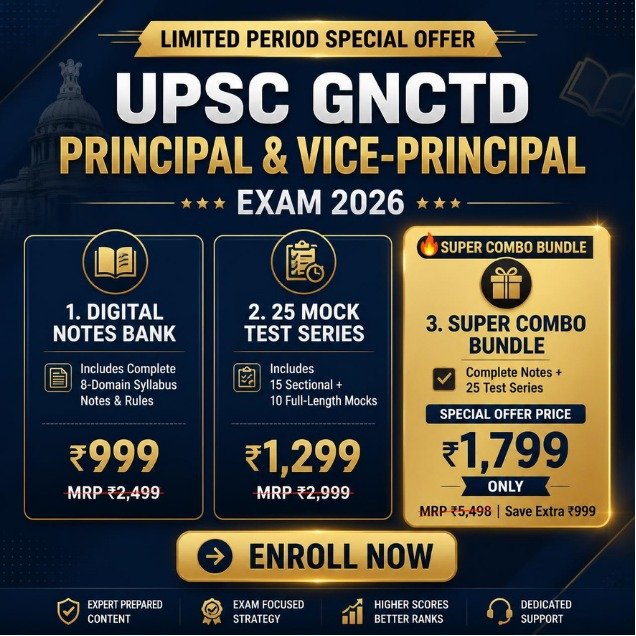
| 1. Digital Notes Bank | Complete 8-Domain Notes (GFR 2017, CCS Rules, Pedagogy, Digital Literacy, Legal Acts, Quant/LR) | ₹ 999/- Click Here(MRP: ₹2,499) |
| 2. Practice Test Series | 25 High-Standard Mock Tests (15 Sectional + 10 Full Length) with 1/3rd Negative Marking & Solutions Demo Test – Click Here | ₹ 1,299/- Click Here(MRP: ₹2,999) |
| 🔥 3. SUPER COMBO BUNDLE | Complete Digital Notes Bank + Full 25 Mock Test Series (End-to-End Pack) | ₹ 1,799/- ONLY (MRP: ₹5,498) Click Here |
Ready to Secure Your Selection?
Click the button below to get instant access to sample modules, complete digital notes, and enroll in the test series.
👉 CLICK HERE TO ENROLL NOW / GET INSTANT ACCESS