
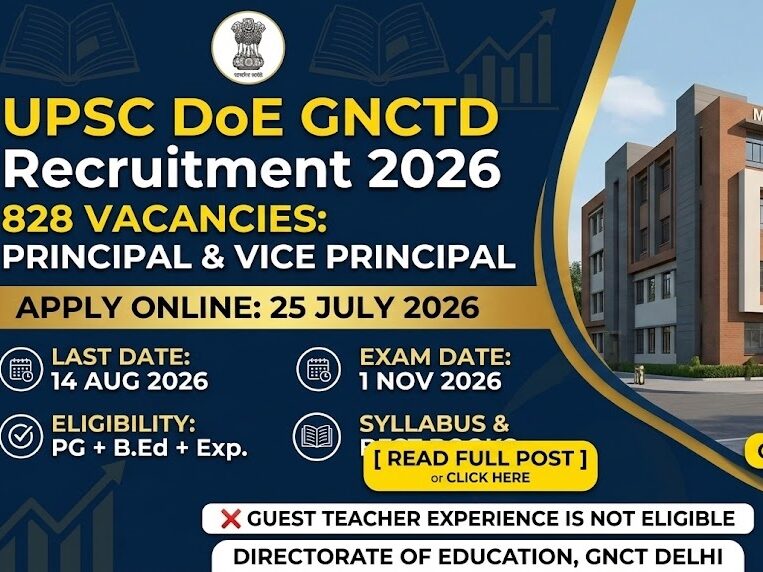
Directorate of Education (DoE), Education Department, Government of NCT of Delhi (GNCTD)
The Union Public Service Commission (UPSC) has officially released the recruitment advertisement for filling 828 vacancies for the posts of Principal and Vice Principal in the Directorate of Education (DoE), Government of NCT of Delhi.
Selection for these Group ‘A’ Gazetted posts will be conducted through a Pen & Paper-based Combined Recruitment Test (CRT) scheduled for 01 November 2026, followed by a Personality Test (Interview).
Below is the complete guide containing online application details, category-wise vacancies, eligibility, the 5-year government servant age relaxation rule, eligibility of Delhi guest teachers, detailed section-wise syllabus, and recommended preparation books.
📅 1. Important Dates & Application Overview
| Parameter | Details |
| Advertisement Number | Special Advertisement No. 51/2026 |
| Notification Release Date | 25 July 2026 |
| Online Application Start Date | 25 July 2026 |
| Online Application Closing Date | 14 August 2026 (18:00 Hours) |
| Combined Recruitment Test (CRT) Date | 01 November 2026 |
| Application Fee | ₹25/- (For General, OBC, and EWS Male candidates)• Exempted (Nil): Women, SC, ST, and PwBD candidates |
| Official Application Portal | UPSC ORA Portal |
📊 2. Vacancy & Pay Matrix
1. Principal — Total 124 Vacancies
- Unreserved (UR): 69 (Male: 37, Female: 32)
- EWS: 11 (Male: 07, Female: 04)
- OBC (Delhi): 18 (Male: 07, Female: 11)
- SC: 16 (Male: 13, Female: 03)
- ST: 10 (Male: 08, Female: 02)
- PwBD (Persons with Benchmark Disabilities): 07 vacancies
- Pay Scale: Level-12 in the Pay Matrix (7th CPC), Group ‘A’ Gazetted, Non-Ministerial.
2. Vice Principal — Total 704 Vacancies
- Unreserved (UR): 287 (Male: 150, Female: 137)
- EWS: 71 (Male: 37, Female: 34)
- OBC (Delhi): 189 (Male: 96, Female: 93)
- SC: 103 (Male: 52, Female: 51)
- ST: 54 (Male: 29, Female: 25)
- PwBD (Persons with Benchmark Disabilities): 28 vacancies
- Pay Scale: Level-10 in the Pay Matrix (7th CPC), Group ‘A’ Gazetted, Non-Ministerial.
Crucial Rule on OBC Reservation: OBC reservation is admissible only to candidates who possess an OBC Certificate issued by the Government of NCT of Delhi. Candidates holding OBC certificates issued by other States/UTs will be treated as Unreserved/General candidates.
🎓 3. Eligibility Criteria, Experience & Age Relaxations
A. Educational Qualifications
- Master’s Degree from a recognized University/Institute.
- Bachelor of Education (B.Ed.) from a recognized University/Institute.
B. Required Teaching Experience
- For Principal: 10 years’ teaching experience (as Vice Principal / Post Graduate Teacher / Trained Graduate Teacher) in a recognized High School / Higher Secondary School / Senior Secondary School / Intermediate College.
- For Vice Principal:
- 2 years’ experience as a Post Graduate Teacher (PGT), OR
- 3 years’ experience as a Trained Graduate Teacher (TGT).
C. Age Limits & Age Relaxations
- Upper Age Limit (for UR/EWS):
- Principal: 50 Years
- Vice Principal: 35 Years
- Category-wise Upper Age Relaxation:
- OBC (Delhi): Relaxable by 3 years (Principal: 53 years, Vice Principal: 38 years).
- SC / ST: Relaxable by 5 years (Principal: 55 years, Vice Principal: 40 years).
- PwBD: Relaxable by up to 10 years (subject to a maximum age cap of 56 years).
🏛️ 5-Year Age Relaxation for Central/UT Government Servants:
Regular Central or UT Government employees who have completed at least 3 years of continuous regular service in the same line or allied cadres are eligible for an upper age relaxation of up to 5 years.
- SC/ST Government Employees: Get a cumulative relaxation of up to 10 years (5 years SC/ST + 5 years Govt. Servant).
- OBC Government Employees: Get a cumulative relaxation of up to 8 years (3 years OBC + 5 years Govt. Servant).
- UR/EWS Government Employees: Get a relaxation of up to 5 years (5 years Govt. Servant).
- Mandatory Requirement: Applicants claiming this concession must submit a ‘Government Servant Certificate’ issued on official letterhead after the date of advertisement by their competent employer.
4. Are Delhi Guest Teachers Eligible for Experience & Recruitment?
NO. As per the explicit terms in the official UPSC recruitment advertisement, service rendered as a Guest Teacher / Guest Faculty cannot be counted towards the required teaching experience.
Official Notification Clause (Section 2, Note II under Experience):
“The period of experience rendered by a candidate on part time basis, daily wages, visiting/guest faculty will not be counted while calculating the valid experience for short listing the candidates for interview.”
Summary for Delhi Guest Teachers:
- Teaching Experience Status: Guest teaching experience in Delhi DoE or any other school is strictly excluded.
- Rejection Criteria: Candidates submitting experience certificates solely as Guest Teachers / Ad-hoc / Contractual daily-wage teachers will have their applications rejected during UPSC scrutiny under the “Lacking Essential Qualification (EQ – Experience)” clause.
- Valid Experience Accepted: Experience is counted only if earned in a regular / continuous full-time capacity in a recognized High/Senior Secondary School or College.
📝 5. Scheme of Examination & Marking Pattern
The Combined Recruitment Test (CRT) for shortlisting candidates for interviews follows this scheme:
- Question Type: Objective Type Multiple Choice Questions (MCQs).
- Total Questions: 120 Questions
- Total Marks: 300 Marks (Each question carries 2.5 marks).
- Duration: 2 Hours (120 Minutes).
- Medium: Bilingual (English and Hindi).
- Negative Marking: 1/3rd mark (0.833 marks) deducted for each incorrect response.
- Selection Merit Weightage: 75 : 25 ratio between Written Test (CRT) marks and Interview marks.
- Minimum Qualifying Marks in Interview (Out of 100):
- General / EWS: 50 marks & above
- OBC: 45 marks & above
- SC / ST / PwBD: 40 marks & above
📚 6. Section-Wise Syllabus
The UPSC Recruitment Test syllabus is divided into 8 main modules:
1. General Knowledge & Contemporary Issues
- Contemporary social, economic, and cultural developments in India.
- Key Government schemes, initiatives, and education-related policies.
- Indian Polity, Constitutional principles, Fundamental Rights, and Governance.
- National and international events, sports, awards, and honors.
2. Language Skills (English & Hindi)
- General English: Reading Comprehension, Sentence Completion, Spotting Errors, Prepositions, Active/Passive Voice, Synonyms & Antonyms, Idioms & Phrases, One-Word Substitutions.
- Hindi Language (सामान्य हिंदी): अपठित गद्यांश, हिंदी व्याकरण (संधि, समास, उपसर्ग, प्रत्यय, कारक, वाक्य भेद), शब्दावली (विलोम, पर्यायवाची, अनेकार्थी शब्द), मुहावरे एवं कहावतें, वाक्य शुद्धि।
3. Reasoning Ability & Quantitative Aptitude
- Reasoning Ability: Analytical Reasoning, Syllogisms, Coding-Decoding, Blood Relations, Number & Alphabet Series, Seating Arrangements, Statement & Assumptions, Direction Sense.
- Quantitative Aptitude: Percentages, Ratio & Proportion, Averages, Profit & Loss, Simple & Compound Interest, Time & Work, Time & Distance, Data Interpretation (Tables, Bar Graphs, Pie Charts).
4. Educational Policies, Measurement & Evaluation
- National Education Policy 2020 (NEP 2020): Core principles, 5+3+3+4 structure, school accreditation (SSSA), PARAKH, Foundational Literacy and Numeracy (FLN / NIPUN Bharat).
- National Curriculum Framework (NCF): NCFSE 2023, Competency-Based Education (CBE), multidisciplinary learning.
- Measurement & Evaluation: Continuous and Comprehensive Evaluation (CCE), Formative & Summative Assessments, Diagnostic Testing, Bloom’s Taxonomy.
- Inclusive Education: Children with Special Needs (CWSN), Gender Sensitivity, Universal Design for Learning (UDL).
- Educational Psychology & Guidance: Principles of child development, theories of learning, Guidance, and Counseling techniques.
5. Management & Financial Administration
- CCS (Conduct) Rules 1964 & CCS (CCA) Rules 1965: Official conduct guidelines, disciplinary actions, inquiry procedures, penalties, and appeals.
- General Financial Rules (GFR): Procurement of goods and services, GeM (Government e-Marketplace) procedures, budget preparation, store management, and auditing.
- FR & SR (Fundamental Rules & Supplementary Rules): Pay fixation, Service Book rules, Joining time, Traveling Allowance (TA/DA), LTC rules, and CGHS regulations.
- CCS (Leave) Rules 1972: Types of leave (Casual Leave, Earned Leave, Half Pay Leave, Commuted Leave, Maternity/Paternity Leave, Study Leave).
6. Office Procedure & Statutory Acts
- Right to Information (RTI) Act, 2005: Provisions, Public Information Officer (PIO) obligations, response timelines, First & Second Appeal processes.
- Protection of Children from Sexual Offences (POCSO) Act, 2012: Legal provisions, duties of School Heads, mandatory reporting protocols, child safety mechanisms.
- POSH Act, 2013: Prevention of Sexual Harassment at Workplace Act, Internal Complaints Committee (ICC) setup, investigation procedure.
- Rights of Persons with Disabilities (RPwD) Act, 2016: 21 specified disability categories, inclusive education mandates, legal rights.
- Manual of Office Procedure (MoOP): Noting and Drafting, File movement, Record retention, official correspondence etiquette.
7. Pedagogy in Education
- Pedagogy and teaching-learning techniques, classroom management, lesson planning, timetable preparation, activity-based learning, ICT-integrated pedagogy.
8. Digital Literacy
- Fundamentals of computers and internet, E-Governance applications, educational portals (DIKSHA, SWAYAM, PM eVidya), cybersecurity basics, data privacy, and applications of AI in school management.
📖 7. Top 5 Recommended Preparation Books
Here are 5 highly recommended books to help you master the UPSC Principal and Vice Principal exam:
1. Swamy’s Handbook for Central Government Servants
- Publisher: Swamy Publishers (C. Muthuswamy)
- Key Topics: Essential for Management & Financial Administration (CCS Conduct Rules, GFR, FR&SR, Leave Rules, LTC, TA/DA).
- Buy Link: Buy Now
2. UPSC Principal & Vice Principal Recruitment Exam Guide
- Publisher: Arihant Publications / R. Gupta’s (RPH Editorial Board)
- Key Topics: Complete single-volume guide covering syllabus subjects, educational policies, office procedures, and practice MCQs.
- Buy Link: Buy Now
3. Educational Administration, Management & School Leadership
- Publisher: English, Hardcover, Dr. Shamshir Singh Dhillon
- Key Topics: In-depth coverage of school leadership, NEP 2020, NCF, CCE, inclusive education, and pedagogy.
- Buy Link: Buy Now
4. General Financial Rules (GFR) & CCS Rules Compilation
- Publisher: Taxmann / Swamy Publications
- Key Topics: Detailed reference for GFR 2017, GeM procurement, RTI Act 2005, POSH Act, and POCSO Act rules.
- Buy Link: Buy Now
5. Fast Track Objective Arithmetic & Analytical Reasoning
- Publisher: Arihant Experts (Rajesh Verma & B.S. Sijwalī)
- Key Topics: High-scoring practice material for Quantitative Aptitude and Reasoning Ability.
- Buy Link: Buy Now
💻 8. Step-by-Step Online Application Process
- Visit the UPSC Portal: Navigate to the official UPSC ORA portal at upsconline.nic.in/ora/.
- URN Profile Registration: Complete your Universal Registration Number (URN) profile.
- Photo & Signature Upload: Capture a live photograph via webcam and upload a clean scan of your signature (signed three times in black ink on white paper).
- Select Post: Select Principal (Vacancy No. 26075101725) or Vice Principal (Vacancy No. 26075102725).
- Upload Documents: Upload clear PDF files of your 10th Class Certificate (Date of Birth proof), Master’s Degree, B.Ed Degree, Experience Certificates, and Caste/Category Certificate (if applicable).
- Application Fee Payment: Pay the ₹25/- fee online using Net Banking, Credit/Debit Card, or UPI (Exempted for Women/SC/ST/PwBD).
- Final Submission: Verify all details carefully, submit the form, and save a printout of the application for future reference.